






Selecting Probes for Oscilloscopes: Passive, Active, and Differential

Selecting Probes for Oscilloscopes: Passive, Active, and Differential
Choosing the right probe is often as important as choosing the right oscilloscope. The probe sits between the signal under test and the instrument, shaping what you see and how faithfully you see it. A wrong choice can load the circuit, distort fast edges, or mask critical anomalies. In this guide, we’ll explore the three main categories of probes—passive, active, and differential—and offer practical guidance for selecting the best option for your measurement needs. We’ll cover the physics behind each type, typical specifications, common use cases, and concrete decision criteria you can apply in the lab or on the manufacturing floor.
Why the right probe matters
An oscilloscope’s input is not a blank canvas. Most modern scopes present a nominal 1 M? input resistance in parallel with a small input capacitance, typically on the order of 10–20 pF. That means the signal you observe is a combined result of the circuit, the probe, and the oscilloscope input. A passive 10× probe, for example, is designed to present roughly 9 M? in series with a small capacitance so that, together with the scope’s input, the overall attenuation is stable and the circuit loading is minimized. If the probe’s bandwidth, attenuation, or capacitance is misaligned with the signal of interest, you can misinterpret timing, overshoot, ringing, or noise levels. In short, a good probe preserves the signal’s shape, voltage, and timing while keeping loading effects acceptable for the circuit under test.
Understanding the three main probe types
Passive probes
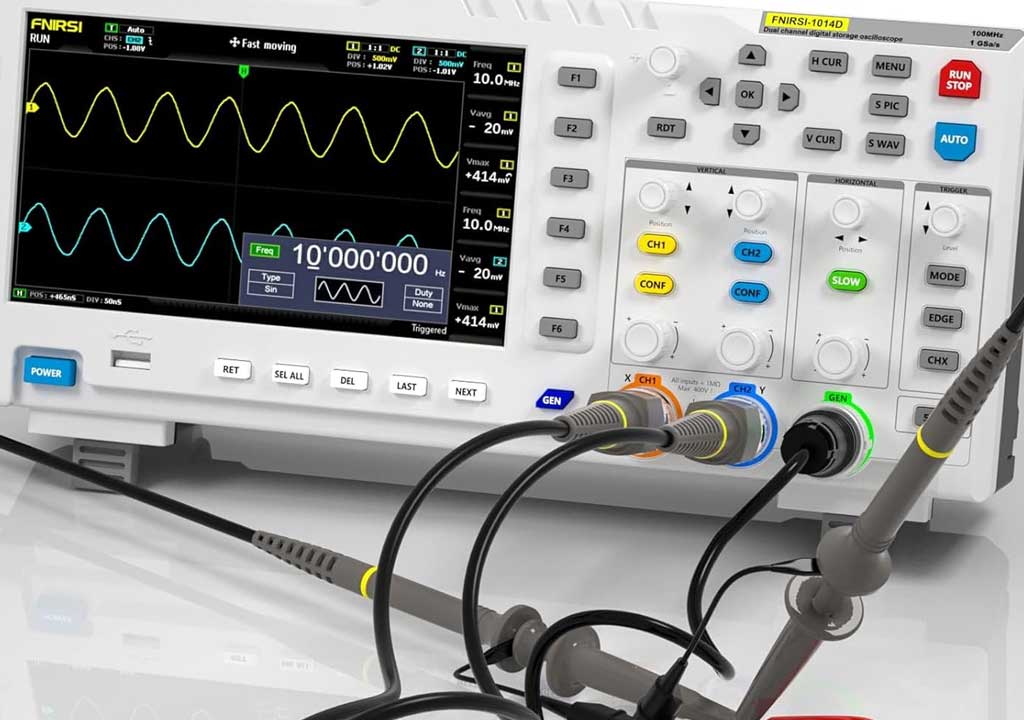
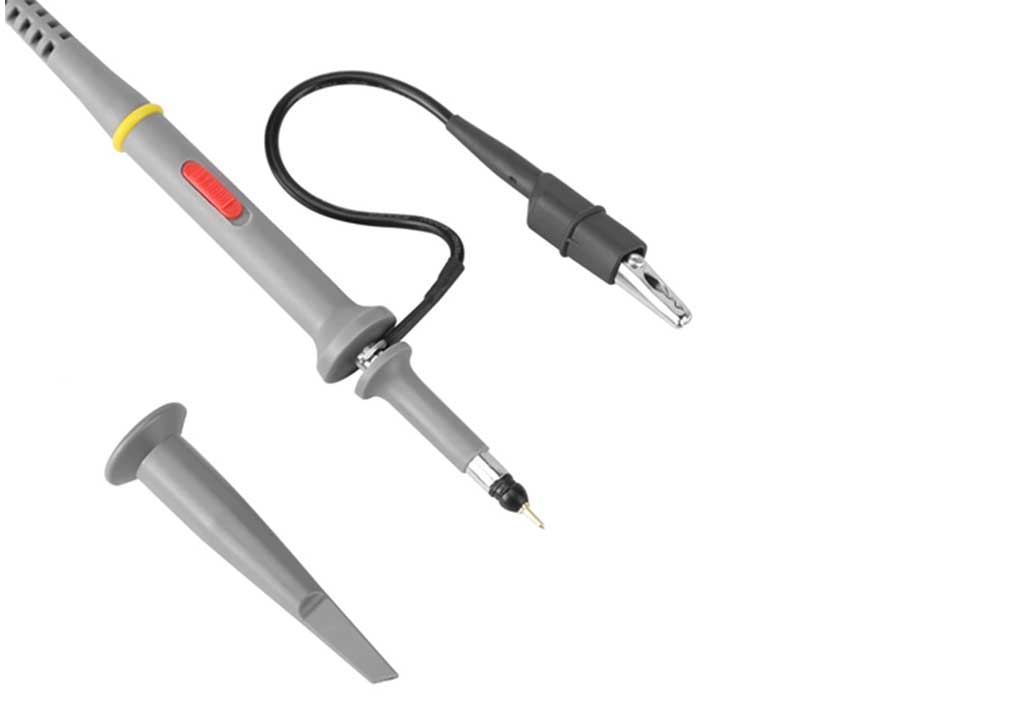
Passive probes are the most common and often the most cost-effective option for a broad range of measurements. They come in multiple attenuation factors—most notably 1× and 10× being the standard. A 1× passive probe is essentially a direct connection to the signal, with relatively high input capacitance and lower bandwidth compared to higher-attenuation probes. A 10× passive probe, by contrast, uses a series resistor network that attenuates the signal by a factor of ten and reduces the load on the circuit at high frequencies, while presenting a much higher impedance to the device under test.
Key characteristics of passive probes include:
- Bandwidth: Ranges from a few tens of megahertz for low-cost probes to several hundred megahertz or more for high-quality 10× probes. The bandwidth must exceed the signal’s content to avoid significant distortion of fast edges.
- Attenuation factor: Common settings are 1×, 2×, 5×, 10×, and sometimes higher. Attenuation must be matched to the oscilloscope’s input to maintain accurate voltage readings and proper signal integrity.
- Input impedance and capacitance: In a 10× probe, the series network reduces the loading on the circuit and the effective capacitance seen by the test point is a critical parameter that affects high-frequency performance.
- Compensation: Passive probes often require a mechanical adjustment (a small screw) to tune the probe’s RC network so that the probe and scope together create a flat frequency response. Improper compensation leads to overshoot, undershoot, or bowed edges, especially on square waves and fast edges.
- Grounding and accessories: Ground leads, tip adapters, and hooks influence measurement integrity. A long ground lead can introduce inductance and oscillations at high frequencies; using a ground spring or short ground connection is often a win for high-speed measurements.
Typical use cases for passive probes include general-purpose debugging of digital signals, analog waveform capture in educational labs, and voltage measurements on low- to mid-voltage circuits where extremely high bandwidth or ultra-low loading is not required. For many engineers, a good 10× passive probe paired with a capable oscilloscope covers a large portion of day-to-day work.
Active probes
Active probes embed a local buffer or amplifier at the probe tip. The buffer isolates the probe from the scope’s input, reducing the effect of the scope’s input capacitance and the loading the probe would otherwise impose on the circuit. This is especially beneficial for high-speed, high-frequency measurements where even tiny input capacitances can distort edges or degrade timing accuracy. Active probes are typically powered by the oscilloscope’s supply or by a dedicated battery pack; some models offer self-contained power.
Key characteristics of active probes include:
- Very high bandwidth: Many active probes support hundreds of megahertz up to several gigahertz, enabling accurate capture of fast digital edges and high-frequency analog signals where passive probes struggle.
- Low input capacitance: A critical advantage for high-speed measurements. The buffer reduces the capacitive loading that the signal “feels,” preserving edges and reducing ringing.
- Attenuation and gain: Active probes can be designed with fixed attenuation (for example, 1× or 10×), or with adjustable gain settings. Some models include built-in amplification to deliver a clean, single-ended signal to the scope.
- Safety and power requirements: Because they include active electronics, these probes require power. They may be more sensitive to power supply noise and sometimes require careful grounding or shielding, especially in noisy environments.
- Stability and calibration: The internal buffer can drift with temperature, so many active probes include compensation routines or self-calibration features to maintain accuracy over sessions and across environmental changes.
When to choose an active probe? If you’re measuring very fast edges (in the hundreds of megahertz to several gigahertz range), or if you need to minimize loading on delicate, high-speed circuits (such as modern SerDes interfaces or high-speed memory), an active probe often outperforms a passive alternative. They’re also advantageous when you’re probing at or near the device under test’s output limits, where extra capacitance would significantly distort the signal.
Differential probes
Differential probes are designed to measure the difference between two signals rather than a signal with respect to ground. This is essential when the signal of interest has a large common-mode voltage or when ground references can’t be easily shared between the test point and the oscilloscope. Differential probes can be passive or active, but they are often categorized separately due to their specialized role and performance characteristics, such as high common-mode rejection ratio (CMRR) and high common-mode voltage tolerance.
Key features of differential probes include:
- Common-mode rejection: A high CMRR means the probe attenuates common-mode signals (the same signal appearing on both input lines) effectively, allowing you to observe the true differential signal with less interference from stray common-mode voltages.
- High common-mode voltage isolation: Differential probes are designed to withstand high voltages on either lead while protecting the oscilloscope from damage and keeping the measurement safe.
- Two input channels from the scope: A differential probe typically connects to two channels on the oscilloscope or uses a single-ended interface with a built-in differential conversion. Some models provide a single-ended output that the scope can display after proper subtraction or using a math channel.
- Bandwidth and input impedance: Differential probes must balance bandwidth with input impedance on each leg, ensuring the measurement does not load the circuit excessively while preserving the signal’s high-frequency content.
- Ground isolation and safety: Because the two leads can float with respect to the scope ground, differential probes are useful in high-voltage applications, motor drives, and switching power supplies where conventional single-ended probes would create ground loops or be unsafe to use.
When to use a differential probe? For high-voltage, floating, or high-common-mode signals; for precise measurement of differential pairs in high-speed interfaces (such as LVDS, HDMI, PCIe differential channels); and when you must maintain CMRR performance and safety in harsh environments.
Key specifications to compare
To pick the right probe, you’ll want to compare several core specifications. Here’s a concise checklist you can use when evaluating models:
- Bandwidth: Ensure the probe’s bandwidth is at least equal to or higher than the highest frequency component in your signal. A common rule is to choose a probe with bandwidth 2–5× the signal’s fundamental or the scope’s bandwidth if you’re pushing the limits of the oscilloscope.
- Attenuation factor and scope settings: Match the probe’s attenuation with the oscilloscope’s input settings. If you’re using a 10× probe, configure the scope to 10× attenuation or rely on automatic probe detection if your instrument supports it.
- Input impedance and capacitance: For passive probes, lower input capacitance is better for high-frequency performance. For active and differential probes, verify the input characteristics per channel as specified by the manufacturer.
- Compensation: Passive probes require accurate compensation to flatten the frequency response. Check whether the probe offers user-adjustable compensation and whether it includes a compensation signal (often a square wave from the scope’s test output) for quick calibration.
- Maximum input voltage and safety ratings: This is critical for HV or automotive measurements. Differential probes, in particular, will specify maximum common-mode voltage tolerance and safety category ratings.
- Grounding and hook options: The availability of ground springs, alligator clips, mini-hooks, and short ground leads can substantially affect measurement quality at high speed. Consider the accessibility of alternative tips for your workflow.
- Physical form factor and cable length: A longer cable can introduce more parasitic capacitance and potential for signal reflections, particularly at high frequencies. Shorter, well-shielded cables with robust strain relief are usually preferable for high-speed work.
- Power supply and calibration: Active probes require power. Some differential probes have built-in calibration routines. If you work in a lab with limited space or variable AC power conditions, verify how the probe is powered and how easy recalibration is in daily use.
- Price and warranty: Probes vary widely in price. Weigh the cost against the performance you actually need, and consider the manufacturer’s warranty and service options for long-term reliability.
How to choose based on your application
Practical selection often comes down to matching the probe to the signal, environment, and the oscilloscope you own. Here are representative scenarios and recommended starting points:
1) You’re debugging digital logic at moderate frequency (tens to hundreds of megahertz):
- Start with a good quality 10× passive probe. It offers low loading compared with 1×, provides adequate bandwidth for many digital signals, and includes compensation adjustments to achieve accurate square-wave responses. Use a short ground lead or a ground spring to minimize inductive loops on fast edges. If you’re measuring narrow, fast edges, verify the probe’s bandwidth and the compensation accuracy before critical measurements.
2) You’re observing high-speed serial interfaces or analog signals near the edge of the technology node (hundreds of megahertz to gigahertz):
- An active 10× probe is often advantageous. It reduces loading from the scope’s input capacitance and helps preserve edge rates and timing. If your scope supports it, choose a model with a shielded cable and stable calibration. For very high-speed differential measurements (e.g., SerDes, PCIe differential signaling), consider a differential or two-channel active probe with excellent CMRR and minimal common-mode leakage.
3) You’re working with high common-mode voltages and need to avoid ground loops or unsafe ground connections:
- A differential probe is the safer and more accurate choice. Look for high common-mode voltage tolerance, high CMRR, and isolation between the test points and the oscilloscope ground. For automotive or industrial environments, confirm safety ratings (CAT ratings) and ensure proper handling procedures.
4) You’re validating power electronics with switching supplies or motor drives:
- A differential probe or a differential-enabled active probe can simplify measuring across switching nodes and high-side/low-side signals without creating ground loops. If you must measure across a wide common-mode range, differential probes tailored for HV or medium voltage are recommended.
5) You’re teaching or doing routine lab work on a budget:
- A solid 10× passive probe often provides the best balance of price, performance, and ease of use. Emphasize proper compensation and grounding techniques, as those two factors dominate measurement quality in everyday experiments.
Practical considerations for reliable measurements
In addition to selecting the right type of probe, several practical practices can dramatically improve measurement quality and reduce the chance of misinterpretation:
- Minimize ground inductance: Use a short ground connection, employ a ground spring, or use a differential setup when possible. Long ground leads are frequent culprits in distorted waveforms and can mask real problems in high-speed signals.
- Compensate correctly: Passive probes must be compensated for, using the oscilloscope’s built-in test signal. Miscompensation produces bowed or peaked edges. If you notice distortion on a known reference signal, recheck compensation and cable routing.
- Match probe to scope: Ensure that the oscilloscope is configured to the probe’s attenuation setting. If the scope cannot automatically detect the probe, manually set the probe factor. Incorrect scaling will distort amplitude readings and timing relationships.
- Be mindful of loading and impedance: For delicate circuits (e.g., high-impedance nodes or high-Q resonant circuits), higher-impedance probes help minimize loading. In low-impedance, fast-switching environments, higher bandwidth is prioritized even if it means a slight increase in loading. Balance is key.
- Protect the equipment and yourself: For HV measurements or potentially hazardous environments, verify safety ratings. Use differential probes with appropriate isolation and follow service manuals and safety guidelines. Do not bypass safety features or attempt improvised shielding that could compromise protection.
Case studies and quick-start checklists
Case Study A: Debugging a 2.5 GHz SerDes signaling chain in a development board.
Recommendation: Use an active differential probe (or two channels with a differential interface) with high bandwidth, low input capacitance, and strong CMRR. Pair with an oscilloscope capable of vector probe compensation if needed. Minimize ground return length by using a short ground path or a ground-spring accessory. Verify calibration with a known reference pattern before deep measurements.
Case Study B: Inspecting a 500 kHz motor drive PWM waveform and a random analog voltage node near ground.
Recommendation: A high-bandwidth passive 10× probe should suffice. Keep ground leads short and use shielded cables. If the PWM waveform has fast edges and ringing, ensure compensation is correct and watch for measurement-induced artifacts on the rise/fall times. If you encounter significant common-mode noise with respect to the oscilloscope ground, a differential probe might be considered for separate channels to isolate the measurement.
Case Study C: Measuring a high-voltage rail with several kilovolts of common-mode voltage isolated from the bench ground.
Recommendation: Use a differential probe with appropriate voltage rating and safety certification. Confirm the scope’s input and the probe’s common-mode rejection are adequate for the signal of interest. Follow all safety guidelines and use proper isolation and shielding when connecting the probe.
Workflow: a practical step-by-step approach
1) Clarify the measurement goals: what frequency components and timing characteristics matter most? Is the aim to observe edge rates, overshoot, ringing, jitter, or long-term stability?
2) Determine the voltage range and common-mode conditions: will the probe see high voltages or floating nodes? Do you need differential measurement?
3) Check gear compatibility: what is the oscilloscope bandwidth, the maximum input voltage, and the available channels? Which probe types are compatible with your scope and your power/environment constraints?
4) Select a probe strategy: passive (10×) for general use; active for high-speed or low-loading needs; differential for high common-mode or isolated measurements. Consider a mixed approach if multiple measurement types are required in a single project.
5) Plan the measurement setup: minimize ground loops, route cables carefully, use appropriate accessories (ground springs, hook tips, probe tips), and ensure proper calibration procedures are known.
6) Calibrate and validate: compensate passive probes, perform a quick check with a known reference signal, and verify amplitudes and timings against expected results. Document the settings for reproducibility.
Maintenance, safety, and best practices
Probes are robust tools, but they require care and proper handling to maintain accuracy and safety:
- Inspect cables and connectors for wear before use. Damaged insulation or bent connectors can cause arcing or inaccurate readings.
- Keep compensation adjustments clean and accessible. Dust and grime can affect tuning screws or calibration routines.
- When transporting probes, use protective caps and avoid bending the cables beyond their recommended bend radius. Excessive flexing can damage internal wiring and shielding.
- For high-voltage or industrial environments, use probes specifically rated for the voltage and safety category you need, and follow your organization’s safety protocols. Do not improvise or bypass safety features in an attempt to measure borderline voltages.
- Periodically verify the probe’s calibration against a reference signal to ensure long-term accuracy, particularly for critical measurements or regulated environments.
Putting it all together: a practical decision matrix
When you’re selecting a probe, you can think in terms of a simple decision matrix that weighs your primary constraints: bandwidth, loading, safety, and budget. Here is a compact framework you can apply:
- If you need to measure low- to mid-frequency signals with minimal cost, and you can tolerate moderate loading, start with a high-quality 10× passive probe.
- If your signals have very fast edges (hundreds of megahertz to gigahertz) or you must minimize loading on the device under test, consider an active probe with high bandwidth and low input capacitance.
- If your signal is floating or you must reject common-mode interference, or if you must measure across high common-mode voltages safely, choose a differential probe—passive or active depending on your budget and precision requirements.
- For high-voltage or specialized measurement campaigns, match the probe’s safety ratings to the environment, and prefer differential probes designed for isolation and protection.
Closing thoughts
The journey from a raw signal to a trustworthy measurement is paved with careful probe selection and disciplined measurement practices. Passive probes are reliable workhorses for many tasks, especially when budget and simplicity are priorities. Active probes push performance into the realm of high-speed measurements where loading must be minimized and bandwidth is king. Differential probes unlock safe, precise observation of signals that live above or far away from the oscilloscope’s ground reference. The best practice is often to pair the measurement goal with a probe type that aligns with the signal’s frequency content, the voltage range, and the environment in which you’re working. By understanding the strengths and limitations of each probe type—and by applying careful setup and compensation—you can extract accurate, meaningful insights from your oscilloscope experiments every time.
Quick reference: sample checklist before a measurement session
- Identify the signal type, bandwidth, and voltage range you plan to measure.
- Choose passive 10×, active, or differential based on speed, loading, and safety requirements.
- Ensure the oscilloscope is configured to the correct attenuation and bandwidth settings.
- Set up short, well-shielded leads and use ground springs where appropriate.
- Calibrate the probe (compensation for passive probes) and validate with a known reference signal.
- Document the setup for reproducibility and future comparisons.
Final takeaway
There is no one-size-fits-all answer to selecting probes for oscilloscopes. The most effective approach is to match the probe to the signal’s needs and the measurement’s goals while applying good practices for grounding, compensation, and safety. Whether you rely on a dependable passive probe for most work, deploy an active probe for challenging high-speed measurements, or turn to a differential probe for high-voltage or isolated measurements, understanding the trade-offs and capabilities of each option will help you obtain accurate, reliable insights from your oscilloscope experiments.
LIKED THIS ARTICLE? SHARE IT: