






Audio, EMI, and RF Troubleshooting: Oscilloscope Techniques for Real-World Circuits

Audio, EMI, and RF Troubleshooting: Oscilloscope Techniques for Real-World Circuits
In the real world, electronic systems live at the intersection of audio performance, electromagnetic interference (EMI), and radio frequency (RF) behavior. A modern oscilloscope is not just a waveform viewer; it is a window into signal integrity, timing, noise, ground reference quality, and the hidden conversations between circuits hidden inside a product. This blog post offers a practical guide to using oscilloscope techniques to diagnose and fix problems across audio, EMI, and RF domains in real-world circuits. The emphasis is on actionable workflow, measurement planning, and interpretation that translates into robust, repeatable results.
Understanding the scope: instrument basics that unlock real-world troubleshooting
Before you can diagnose, you must understand the tools. Oscilloscopes come with a spectrum of capabilities, and selecting the right tool for the job saves time and prevents misinterpretation.
Key parameters to consider include:
- Bandwidth: The highest frequency where the scope can accurately display a waveform. For audio work (roughly 20 Hz to 20 kHz), even a modest 50–100 MHz bandwidth is more than sufficient. For RF work up to several hundred MHz or GHz, you’ll need scopes with multi-hundred MHz to multi-GHz bandwidth.
- Sample rate: At least 5–10 times the highest frequency of interest to avoid aliasing and to capture fast transients. A 100 MHz waveform ideally needs a 1 GS/s or faster sample rate per channel for clean measurements, though practical noise considerations may slightly relax this.
- Vertical sensitivity and dynamic range: A wide vertical range helps to see small signals on top of large ones. Probes and access to the circuit under test may limit the usable dynamic range.
- Trigger system: Robust triggering (edge, pulse width, video, phase, and advanced triggers) is essential for stable measurements and for capturing sporadic EMI events or RF bursts.
- Math and analysis features: FFT spectrum, time–frequency analysis, and built-in filtering help you characterize noise floors, harmonics, and modulated signals.
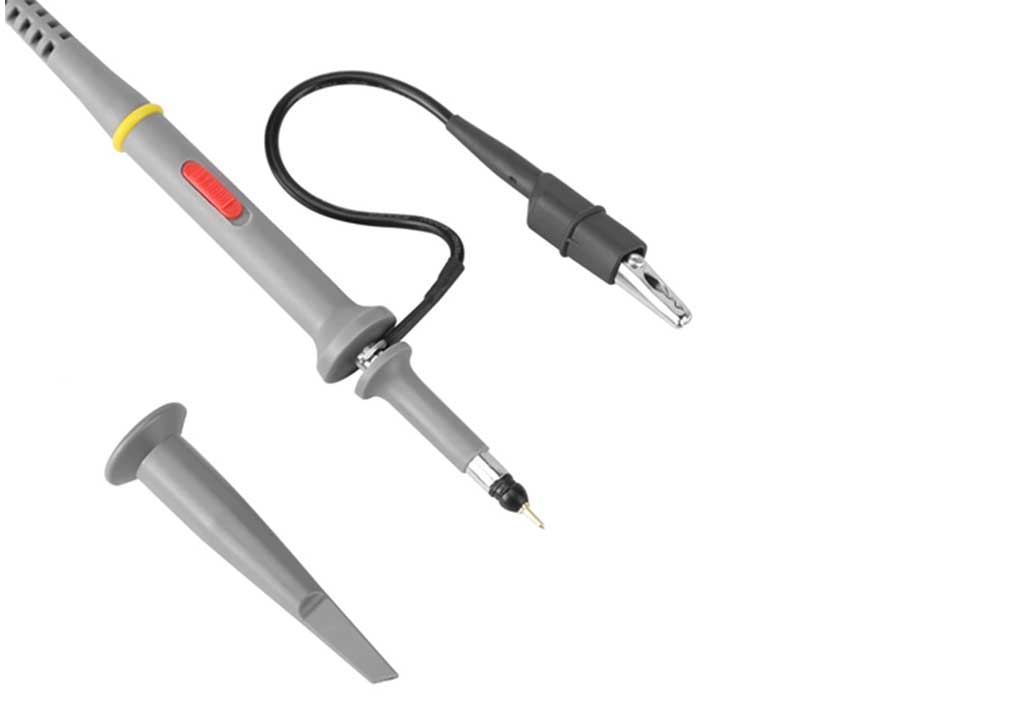
Probes are perhaps the most critical interface to your circuit. A good probe helps you see what the circuit is doing without distorting it excessively. The most common setup uses 10:1 passive probes, which typically present about 10 M? input impedance and a suitable bandwidth for most tasks. For high-frequency work, specialized active probes or differential probes can reduce loading effects and measure signals that aren’t easily referred to ground.
Probes require proper compensation to ensure the displayed waveform is flat and accurate across frequencies. A mis-compensated probe can distort square waves, mask ringing, or misrepresent peak amplitudes. Always verify probe compensation with the oscilloscope’s built-in calibration signal or a known reference signal.
Preparing measurements: safety, grounding, and measurement discipline
In real-world circuits, a large portion of debugging time goes into setup and safe, repeatable measurements. A few disciplined practices pay off immediately:
Grounding matters: Ground loops and improper grounding are the primary sources of hum, noise, and erroneous readings. Use the shortest possible ground lead for the probe, and prefer ground springs or tip-and-barrel connections for high-frequency measurements. When measuring near power supplies or metal enclosures, ensure the reference ground is tied to the same earth ground as the equipment you’re using to avoid floating-ground confusion.
Use the right ground reference: For differential or single-ended measurements, decide whether you need a ground-referenced measurement or a true differential view. For high-speed RF nodes, a differential probe or a pair of channels with a subtraction math function often yields the most faithful picture without injecting ground loops into the circuit.
Power-down procedures and ESD: When probing sensitive analog circuitry, avoid creating unintended DC paths that can inject noise or damage devices. Use power-down when connecting probes to high-voltage nodes, or use isolation (opto-coupled or battery-powered test jigs) if necessary.
Shielding and cabling: Use shielded cables and well-mated, tightly coupled connections for high-frequency work. Keep measurement loops small; long leads act as antennas and introduce spuriously radiated signals that obscure the circuit’s true behavior.
Plan your measurement strategy: Start with a baseline. Identify the signal path you care about, determine the expected bandwidth, and then outline a minimal set of measurements that answer the critical questions. This prevents chasing symptoms rather than root causes.
Audio troubleshooting: identifying noise, distortion, and timing issues
Audio circuits demand clean, low-noise signals with no unintended modulation or distortion. Oscilloscope techniques help you quantify noise floor, hum, distortion harmonics, and transient events that degrade perceived audio quality.
Baseline waveform inspection: Capture the primary audio signal (for example, a DAC output, microphone preamp, or line-level signal) using a suitable bandwidth, then examine the waveform for clarity, clipping, or truncation. Use AC coupling if you wish to center the waveform around 0 V for analysis without DC offset interference.
Frequency-domain analysis with FFT: Most scopes offer FFT analysis. Use FFT to visualize the harmonic content of a waveform. A clean sine wave should show a single carrier line with minimal harmonics; extra lines indicate distortion (even-order harmonics often point to clipping, odd-order to nonlinearities in active devices). For music or complex signals, FFT reveals dominant spectral components, hum at 50/60 Hz, and unwanted intermodulation products from nearby switching supplies or other equipment.
Measuring noise and hum: Measure the noise floor by turning off the excitation and letting the signal settle, then observe the RMS noise level. If you observe a 50/60 Hz hum, inspect grounds and shielding. Use a notch filter or narrow-band FFT to determine whether hum is dominant at the line frequency or exhibits harmonics. If possible, temporarily ground-loop isolate parts of the circuit to locate the noise source.
Transient analysis and timing: In audio, transient response can be as important as steady-state accuracy. Use a step input or an impulse (where safe) to measure rise time, overshoot, and recovery. A well-behaved audio path shows controlled transient behavior without large overshoot or ringing. Ringing often points to poorly damped LC networks, long interconnects, or inadequate damping in audio filters.
Differential measurements for speaker outputs: When measuring speaker outputs or differential amplifier nodes, use differential probes or two channels with a mathematical subtract to avoid common-mode noise. This strategy yields a cleaner view of the true signal difference across outputs or across a bridge-tied load (BTL) configuration.
EMI and RF troubleshooting: moving beyond the audio band
EMI and RF problems often appear as subtle spikes, bursts, or broadband noise that do not respect audio band boundaries. RF measurements demand higher bandwidth, careful probing, and sometimes alternative techniques to visualize fast transients and radiated fields.
Characterizing the spectrum: Use the scope’s built-in FFT to inspect the spectral content of a signal. Look for unexpected spikes that align with harmonics of switching frequencies, clock frequencies, or external transmitters. Compare spectra across different circuit states (idle, active, and under load) to identify EMI sources and their modulation patterns.
Near-field probing and antenna considerations: For radiated EMI, near-field probes (small loop or electric probes) can localize sources by proximity scans. Keep probes well-shielded and minimize the length of the probe itself to avoid introducing additional emissions. If available, use a shielded test fixture or an RF enclosure to control the environment during measurements.
Grounding strategies for EMI: EMI often hides behind ground loops and poor shielding. Use a dedicated device ground, isolate digital grounds from analog grounds where appropriate, and route sensitive analog circuitry away from high-current, noisy power rails. If a ground loop is suspected, inject a known signal into the loop and observe the resulting hum spectrum; then implement a proper star grounding or ferrite bead strategy to break the loop at strategic points.
Power-supply ripple and switching noise: Many EMI problems originate from switch-mode power supplies (SMPS) or DC-DC converters. Use a low-noise, high-bandwidth measurement to observe ripple on the supply lines and on sensitive analog rails. A simple approach is to measure supply rails with the oscilloscope in parallel with a low-noise reference or a dedicated power-supply probe. If ripple is significant, investigate input filtering, layout, and decoupling strategies (proper capacitor placement, adequate ESR values, and appropriate loop areas).
Cable and shielding integrity: Poor cable shielding or unbalanced coax can radiate or pick up emissions. Examine the signal integrity with a reference measurement on a short, well-shielded test lead. If shielding is insufficient, upgrade shielding or convert to twisted-pair wiring with proper differential signaling where possible. In RF, even small gaps in shielding or mismatched impedance can produce significant reflections and EMI.
Oscilloscope techniques that work across audio, EMI, and RF
Here are practical techniques you can apply in many scenarios, with notes on when and why to use them:
- Use appropriate probes: For high-frequency work, passive 10:1 probes with proper compensation or active / differential probes minimize loading and improve accuracy. For current measurements, current probes (clamp-on or Rogowski coil types) offer non-contact methods to monitor switching currents without perturbing the circuit.
- Consider proper grounding and reference schemes: Short ground leads and, when possible, a dedicated measurement ground reduce noise introduction. Differential measurements are essential when you cannot guarantee a common ground path because the signal is ground-referenced at a different node.
- Capture both time-domain and frequency-domain information: Time-domain reveals transients and timing, while FFT shows spectral content, harmonics, and EMI. Use both views to form a complete picture.
- Trigger discipline matters: Use edge triggers for clean basic waveforms; use pulse, video, or advanced triggers for intermittent EMI or RF bursts. A stable trigger prevents misleading interpretations caused by drifting or sporadic events.
- Baseline and control experiments: Record measurements when the system is quiet and when it is under normal operation, then vary potential noise sources (e.g., plugging/unplugging equipment, adjusting cables) to identify responsible elements.
- Time-correlated measurements: If you suspect a correlation between a digital event and an EMI spike, use the scope’s multi-channel timing measurements (phase, skew, triggers) to quantify the relationship and locate sources.
- Use persistence and envelope modes: In RF or EMI events, persistence helps visualize rare events, while envelope mode shows the evolution of a repeating waveform's amplitude over time, useful for identifying slowly varying RF signals or modulated noise.
- Measure with differential or isolated references when needed: If you must measure a signal riding on a high common-mode voltage, use a differential probe or an isolated channel to prevent the scope from being overwhelmed by common-mode signals.
Differential and current-probing techniques: when single-ended measurements fail
Many real-world circuits operate with signals that are not easily referred to ground. In audio, you might measure across a balanced line; in RF, you may want to observe a differential pair; in power electronics, current flows may be high and not conveniently ground-referenced. Here are practical approaches:
- Differential probes: These let you measure the voltage difference between two nodes without creating ground loops. They are invaluable for RF pins that float relative to the chassis or for precise measurements across a transformer secondary or a balanced audio line.
- Math channels to subtract channels: If a differential probe isn’t available, you can use two channels and the scope’s math function to subtract one trace from another. Ensure paralleled channels have identical probe compensation to avoid introducing errors.
- Current measurement: For switching regulators, motor drives, or audio power amps driving loudspeakers, use a current probe to monitor instantaneous current and its relation to voltage waves. Current waveforms reveal switching events and impedance changes in the supply line that can trigger EMI.
Step-by-step workflow for real-world problems
When you encounter a fault, a repeatable workflow helps you isolate and fix the root cause efficiently. Here is a practical, reusable workflow you can adapt to audio, EMI, or RF problems:
- Define the problem: What symptom do you observe? Is there hum, noise, distortion, intermittent clipping, or unexpected spurious emissions? Document when it happens (under load, at startup, after a temperature change, when a cable is moved).
- Establish safe baselines: With power off, verify the expected static readings (DC offsets, resistor dividers, known reference voltages). Then power up with precautions and monitor a few stable, repeatable signals to set a baseline.
- Sample the dominant signals: Identify the dominant audio, switching, or RF frequencies. Set the scope bandwidth and timebase to capture the essential cycles. Use a 10x probe if you expect high-frequency content to minimize loading.
- Isolate the noise source: If you suspect EMI, systematically disconnect or shield potential noise sources, moving cables away from the signal path, and comparing the measurements with those changes. Document the effect of each change in a controlled manner.
- Correlate with system state: Observe signals during the exact state when the problem occurs (e.g., during a power-up inrush, during switching, during audio dynamic range changes). Use triggers to capture the event repeatedly.
- Characterize your findings: Use FFT to identify harmonic structures and spurs. If you suspect a ground loop, compare measurements with different grounding arrangements. For RF issues, measure across potential impedance mismatches and verify Kabels and connectors.
- Iterate and validate fixes: Implement a fix (shielding, grounding, decoupling, layout change, or component substitution) and re-measure to confirm the improvement. Ensure the fix does not introduce new issues elsewhere in the system.
Case studies and example workflows
Below are two representative scenarios illustrating how oscilloscope techniques guide real-world troubleshooting in audio and RF contexts. Each case emphasizes practical steps, measurement choices, and interpretation.
Case A: Hum and ground-loop interference in an integrated audio platform
A compact audio interface exhibited a persistent 60 Hz hum and sporadic buzz when connected to certain laptops. The symptoms suggested a ground-reference problem or shared impedance between the line-level path and the digital ground.
Approach and actions taken:
- Used a 10x passive probe on the analog output stage, with the oscilloscope grounded to the same chassis ground as the interface. Confirmed a small AC ripple riding on the DC bias of the output stage.
- Swapped to differential measurement across a balanced line pair to remove common-mode components. Found that the measured differential signal carried a small but noticeable 60 Hz component.
- Shortened probe ground leads and introduced a star grounding configuration, tying the chassis, signal ground, and AC mains ground together at a single point near the power entry. Re-measured; hum magnitude dropped by an order of magnitude.
- Monitored the power rails with a high-bandwidth probe, noting ripple correlated with the mains frequency and with the laptop’s USB power activity. Added localized decoupling and better shielding around the DA conversion stage, and rerouted sensitive analog traces away from digital ground loops. Post-fix measurements showed the harmonics of the 60 Hz component were largely suppressed, with the FFT showing little residual energy at the fundamental line frequency.
Takeaway: Ground loops are a frequent culprit in audio systems. A disciplined approach combining differential measurements, careful grounding strategy, and strategic shielding resolves many hum-related issues.
Case B: RF leakage and unintended coupling in a wireless sensor node
A battery-powered wireless sensor node exhibited an unexpected burst of RF energy that appeared to modulate the LCD display’s power consumption, causing occasional glitches. The problem surfaced primarily when the node’s RF transceiver was active, suggesting leakage or coupling that modulated supply lines.
Approach and actions taken:
- Monitored the RF output with a high-bandwidth RF probe and observed spectral lines corresponding to the transceiver’s clock, along with a lower-frequency envelope correlated to the display activity.
- Used an isolated differential measurement across the supply rails to quantify power-supply ripple during RF bursts. Found that instantaneous current draw increased during transmission, causing small voltage dips on the supply that coincided with visible display glitches.
- Introduced proper decoupling near the RF transceiver and the display, added a buffer stage to isolate RF transients from the display’s supply, and implemented shielding around sensitive analog sections. Re-tested across multiple operating modes, including worst-case duty cycles for RF bursts.
- Re-measured using FFT to confirm suppression of emission lines at the known switching frequencies of the transceiver and the absence of new spurs introduced by the shielding modifications.
Takeaway: RF transceiver activity can couple into power and other sensitive rails via shared return paths or inadequate decoupling. A methodical measurement plan—spectral analysis, differential sensing, and targeted shielding—helps isolate and remedy coupling paths.
Practical tips and best practices for real-world boards
Below are actionable guidelines to improve your troubleshooting effectiveness in everyday practice:
- Start with a clean bench and defined references: Remove unnecessary cables and sources of noise from the measurement environment. Use a dedicated, well-bounded ground plane or test jig for sensitive measurements.
- Minimize measurement intrusion: Probe loading can alter circuits, especially at high frequencies or with high-impedance nodes. Prefer higher-impedance probes and short ground leads. If you must measure a high-speed node, differential or active probes are often better choices than grounding via long leads.
- Document and repeat: Save waveform captures and settings. Repeat measurements after changes to verify that improvements persist under different conditions, including temperature variations and different loads.
- Use shielding and containment when needed: For EMI investigations, enclose the entire test setup in a shielded box to reduce external interference and to differentiate self-generated emissions from environmental noise.
- Leverage multi-channel triggers: Synchronize multiple signal measurements to understand timing relationships. For example, trigger on a transceiver’s transmit start and observe the RF waveform, power supply ripple, and digital control signals in parallel.
- Cross-check with other instruments when possible: If you have access to a spectrum analyzer, a network analyzer, or a vector signal analyzer, use complementary measurements to confirm oscilloscope observations, especially for high-frequency behavior and impedance characteristics.
Environment, layout, and design considerations pedagogy
While the oscilloscope is a powerful diagnostic tool, many issues originate in the design and layout of the circuit itself. A few design habits, if adopted early, can dramatically reduce debugging time later:
- Keep critical analog paths short and direct: Minimize loop areas and ensure tight routing for high-impedance nodes. Use dedicated analog power rails with adequate decoupling and proper separation from digital circuits.
- Plan grounding and shielding in the PCB layout: Use star grounding concepts, route sensitive grounds away from noisy power rails, and provide shielded enclosures or ground planes to minimize EMI susceptibility and emission.
- Control impedance and routing: For RF, maintain controlled impedance traces, especially near RF connectors, antennas, and high-speed digital interfaces. Use proper terminations where appropriate to reduce reflections.
- Decouple and isolate: Place decoupling capacitors close to power pins, use ferrite beads to suppress high-frequency noise, and isolate digital and analog grounds where feasible with careful return-path management.
Choosing the right strategy: when to escalate to more advanced tools
Oscilloscopes are excellent for time-domain and many frequency-domain measurements, but some problems require specialized instruments or techniques:
- When to use a spectrum analyzer: If you need precise spectral density estimates or to characterize radiated emissions and conducted EMI across broad frequency ranges, a spectrum analyzer with appropriate preamplifiers and detectors is invaluable.
- Vector signal analyzer for modulation analysis: For complex RF signals with known modulation schemes, a vector signal analyzer or a modern oscilloscope with advanced demodulation capabilities can be used to observe phase and amplitude relationships.
- Near-field probes or antenna measurement systems: For detailed EMI localization and antenna characterization, near-field-probe-based measurement setups and small-loop sensors help pinpoint emission sources and antenna impedance problems.
- Time-domain reflectometry (TDR) for impedance and trace integrity: If you suspect impedance discontinuities, TDR can reveal reflections along cables and PCB traces, guiding layout corrections and terminations.
Conclusion: turning oscilloscope measurements into robust circuit health
Oscilloscopes are a cornerstone of real-world audio, EMI, and RF troubleshooting. The value they provide comes not just from capturing a waveform, but from a disciplined approach to measurement planning, grounding, probe selection, and thoughtful interpretation. By combining time-domain observations with frequency-domain insights, you gain a holistic view of how signals behave in the wild—across the audio path, through the heart of EMI sources, and into the RF front-end.
Practical measurement strategies—starting from baselines, using differential and isolated sensing where necessary, and applying targeted shielding and grounding improvements—translate into tangible improvements: reduced noise, fewer glitches, higher RF performance, and more robust devices. As with any engineering discipline, the key is to work methodically, document results, and validate fixes under realistic operating conditions. With the oscilloscope as your guide, you’ll move from guesswork to evidence, from symptoms to root causes, and from fragile prototypes to reliable products.
Glossary and quick-reference checklist
For quick recall during a long debugging session, here is a compact checklist you can print or keep nearby:
- Bandwidth and sample rate aligned with the highest frequency of interest; ensure Nyquist considerations are respected.
- Probes with proper compensation; prefer 10:1 for high-frequency work; use differential probes when necessary.
- Minimize ground leads; use ground springs or short ground connections; consider differential measurements to avoid ground loops.
- Baseline measurements before changes; capture both time-domain and frequency-domain representations.
- Triggering tuned for the event of interest (edge, width, video, or advanced triggers).
- FFT and spectral analysis to identify harmonics, spurs, and EMI signatures.
- Systematic isolation experiments to locate noise sources and coupling paths.
- Shielding, proper cable management, and layout considerations to reduce emissions and susceptibility.
- Document changes and validate improvements under multiple operating conditions.
Closing thoughts: embracing real-world complexity with calm, methodical measurement
The world beyond the schematic is messy, with noise, crosstalk, and parasitics lurking at every corner. An oscilloscope, wielded with discipline and curiosity, helps you see through the complexity. Whether you’re chasing a stubborn audio hum, a ground-loop gremlin, or a misbehaving RF link, the core approach remains the same: define the phenomenon, measure with care, interpret in context, and verify with repeatable experiments. The result is not only a fix for today but a design habit that yields robust performance for tomorrow's devices.
Further resources
If you want to deepen your practice, consider these topics and resources:
- Oscilloscope probe compensation tutorials and calibration references
- Design guides on grounding, shielding, and PCB layout for EMI/EMC compliance
- RF measurement techniques, including near-field scanning and impedance control
- Power integrity and decoupling strategies for noise-sensitive analog circuits
With the right mindset and the right measurement strategy, oscilloscope-based troubleshooting becomes an efficient, repeatable pathway to sound, compliant, and reliable electronic systems. Happy debugging!
LIKED THIS ARTICLE? SHARE IT: